In mid-2026, the global container shipping market has stepped out of a unified trend and presented a structurally divergent market pattern. Leading liner companies are rapidly adjusting their global capacity layout according to the demand heat and profitability of regional markets. While export demand in India remains sluggish with route capacity shrinking, China’s export market maintains robust momentum with continuous capacity expansion. Coupled with surging peak season surcharges on US and Canada routes, the Trans-Pacific shipping market has ushered in an early peak season upward trend, setting a new tone for the foreign trade logistics landscape in the second half of the year.
I. Polarized Market: Indian Routes Slump with Continuous Capacity Reduction
The most prominent feature of the current global shipping market is the stark regional disparity in market performance. MSC, the world’s largest liner company, has recently announced the suspension of the "Indus Express", a core main route connecting India’s west coast and the US East Coast. As one of MSC’s two key routes serving the India-US East Coast market, its suspension leaves only one operational route to maintain basic services, which is widely regarded by the industry as a definite signal of a failed peak season for India’s exports.
The downturn in India’s export market is fully evident. Market data shows that the spot freight rate for 40ft containers from India to the US East Coast has lingered steadily at USD 2,000–2,500 per box for the past month, lacking the typical peak season price surge and standing in sharp contrast to the prosperous market in previous years. Multiple factors have led to this slump. On the one hand, the Indian market has witnessed massive new capacity inflows over the past year, while export demand has failed to keep pace, resulting in a severe supply-demand imbalance. On the other hand, escalating geopolitical tensions in the Middle East have fueled market wait-and-see sentiment, prompting most shippers to postpone shipments and dragging down overall cargo volume growth.
Against this backdrop, liner companies have adopted aggressive capacity contraction strategies, including route suspensions, service cancellations, blank sailings, and frequency cuts to stabilize freight rates and ease supply-demand conflicts, pushing India’s shipping market into a sustained downward cycle.
II. China’s Exports Lead Globally with Leading Carriers Expanding Trans-Pacific Capacity
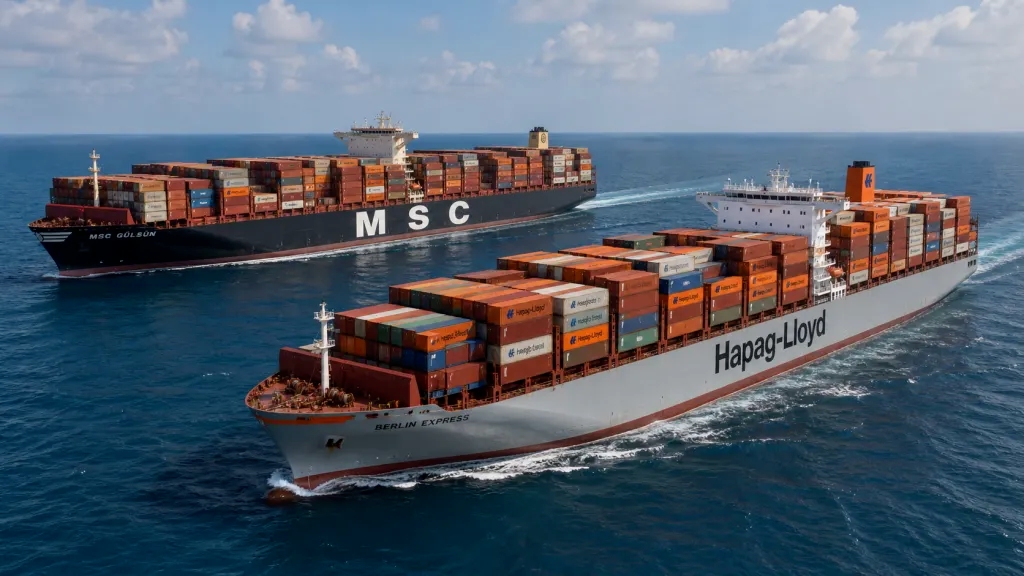
In stark contrast to the sluggish Indian market, China’s export market boasts strong resilience and booming demand, becoming the core focus of global liner capacity deployment. While scaling back Indian routes, MSC has optimized its global network by relaunching its premium Trans-Pacific express service "Pearl Service", offering direct shipments from China’s Yantian and Xiamen Ports to the US Long Beach Port. The maiden voyage, operated by the MV MSC Lyse V, departed from Yantian Port on June 13, marking a significant capacity upgrade for China-US trunk routes.
This strategic shift of capacity withdrawal from weak markets and investment in high-potential regions highlights the core logic of the current shipping industry: global capacity is rapidly converging toward China’s export market with strong demand and higher profit margins. Currently, freight rates on China-US routes are substantially higher than those on India-US routes, with some routes recording several times the price gap. The Trans-Pacific peak season market continues to heat up, featuring tight vessel space, frequent container rolling and offloading, and an increasingly strained supply-demand relationship.
III. Dual Price Hikes Implemented on US & Canada Routes Driving Up Logistics Costs
As the peak season kicks off early, price hikes continue to sweep US and Canada shipping routes. Following the General Rate Increase (GRI) announced in May, COSCO SHIPPING Lines has released another official notice to levy Peak Season Surcharge (PSS) on all cargo exported from the Far East, Oceania, the Indian subcontinent, and the Middle East to the United States and Canada, effective from June 15 to June 30, 2026. The detailed charging standards are as follows:
20GP: USD 1,600 per container
40GP/40HQ: USD 2,000 per container
45HQ: USD 2,532 per container
Notably, the newly imposed PSS will be superimposed with the previously announced GRI. Effective from July 1, the GRI will raise rates by up to USD 3,000 for 40ft standard containers and USD 3,375 for 40ft high cubes on US routes, with rates for Canadian routes remaining largely consistent with the US market.
Industry professionals clarify that the two surcharges serve different purposes: PSS is a temporary charge triggered by skyrocketing demand and tight space during peak seasons with short-term validity, while GRI is a long-term adjustment tool for carriers to optimize the overall freight rate system. The superposition of the two charges will significantly lift the overall logistics costs for US and Canada-bound shipments.
IV. Market Outlook: Sustained Peak Season Momentum and Further Rate Upside
Based on current market fundamentals, the 2026 Trans-Pacific peak season has started ahead of schedule with ample room for further rate growth. Two core factors underpin the upward trend: first, US import demand continues to recover, and numerous shippers advance shipments to seize favorable trade policy windows, driving steady cargo volume growth; second, major liner companies maintain strict capacity control and price protection strategies, making the supply shortage on popular routes a persistent trend.
Leading carriers including MSC and COSCO SHIPPING continue to optimize their global capacity structure by reallocating vessel resources to high-yield Trans-Pacific routes. For domestic exporters and freight forwarders, concentrated capacity investment has slightly eased space pressure on partial routes but cannot reverse the overall supply shortage.
With the arrival of the full-blown traditional peak season in July, capacity adjustment and price competition among global liners will intensify. Market consensus suggests that driven by growing cargo volumes, tightening capacity, and overlapping surcharges, freight rates for US and Canada routes will keep climbing and are expected to hit new highs in 2026.
V. Shipping Recommendations for Foreign Trade Exporters
In view of the highly divergent and price-volatile shipping market, exporters are advised to arrange shipment plans in advance. It is recommended to lock in vessel space on popular China-US routes upfront to avoid shortages and continuous rate hikes, optimize shipment schedules, and reserve sufficient logistics cycles and cost budgets. This will effectively mitigate operational uncertainties caused by peak season market fluctuations and ensure stable and smooth supply chain operations.




 EN
EN




 Hot News